How to Find Your Skin Type at Home
By the DermaVault Editorial Team ·
Wash your face, pat it dry, leave it bare and wait 30 minutes. Shine all over suggests oily skin, tightness or flaking suggests dry, shine only on the forehead, nose and chin suggests combination, and skin that feels comfortable is normal. Sensitivity is separate and can sit alongside any of these.

Wash your face, pat it dry, put nothing on it and wait 30 minutes. Then look at it and touch it. Shine all over suggests oily skin. Tightness or flaking suggests dry. Shine only on your forehead, nose and chin suggests combination, and skin that simply feels comfortable is what is called normal.
That is the whole test, and it is the one Cleveland Clinic describes. The rest of this post covers how to do it properly, how to read the result, and what to buy once you know.
What are the skin types?
Skin type is mostly a description of how much oil (sebum) your skin makes. Sebum is the oily substance that lubricates the surface. The American Academy of Dermatology (AAD) and Cleveland Clinic both use the same five labels.
| Type | What you tend to notice |
|---|---|
| Oily | A shiny face, larger-looking pores, blackheads, a tendency to clogged pores and spots |
| Dry | Skin that looks dull and feels tight or scaly, with fine lines that show more |
| Combination | An oilier forehead, nose and chin (the T-zone), with drier cheeks and eye area |
| Normal | No obviously dry or oily areas |
| Sensitive | Redness, stinging, burning or itching, often in response to products |
The first four sit on one scale, from more oil to less. Sensitive skin is a different kind of label, and there is more on that below.
How do you test your skin type at home?
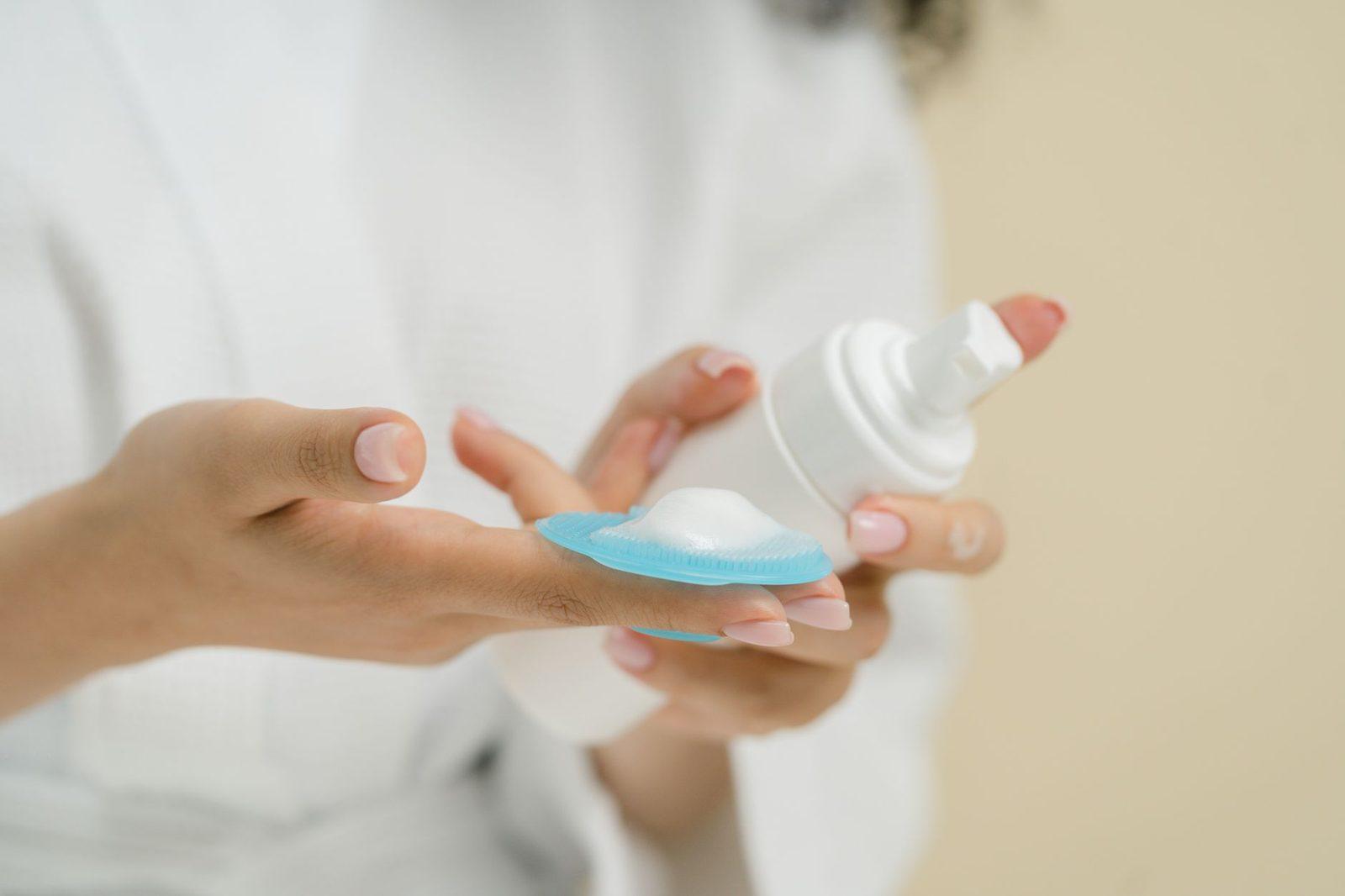
You need a gentle cleanser, a towel and half an hour.
- Wash your face with a mild cleanser and warm water, using your fingertips. Skip the flannel and the scrub.
- Pat it dry.
- Leave it bare. No moisturiser, serum or sunscreen, so do this at home when you are not about to go out.
- Wait 30 minutes.
- Look in a mirror in daylight, and touch your forehead, nose, chin and cheeks.
- If you have blotting paper, press a sheet gently against your T-zone and then your cheeks.
On the blotting paper: the AAD's advice for using it is to press it against the skin for a few seconds and not to rub.
One note on the method. Cleveland Clinic's instructions are to wash, dry and wait 30 minutes. Leaving your skin bare during the wait follows from that, since anything you apply would change what you see.

What do the results mean?
Cleveland Clinic's guide to reading the test is short.
- Oily. Your skin feels oily after about 30 minutes.
- Dry. Your skin still feels dry after 30 minutes.
- Combination. Some areas are dry while others are oily.
- Normal. Your skin doesn't feel tight or oily after washing.
If you used blotting paper, the amount of oil on each sheet adds to the picture. Oil on both the T-zone and the cheek sheets points towards oily skin, and oil on the T-zone sheet alone points towards combination.
If you felt stinging, burning or itching during the test, or your skin went red after cleansing, make a note of it. That points to sensitivity, whatever the oil result.
The test is a rough guide. In research, oiliness is measured with instruments. A review in the Journal of Clinical and Aesthetic Dermatology gives the average rate of sebum production as 1 mg per 10 cm² of skin every three hours, with less than 0.5 mg counted as dry and more than 1.5 mg as excessive. A fingertip can't measure that, so expect a sensible estimate.
Dry results deserve a second look. Skin that feels tight but still gets shiny may be short of water more than oil. Dry skin vs dehydrated skin explains the difference.
Can your skin type change?
Yes, and this is why one test isn't the final word.
Cleveland Clinic says skin type can change over your lifetime and even between summer and winter. Hormonal changes such as puberty, pregnancy and breastfeeding can shift it, as can stress, diet and medication.
The oily skin review fills in some detail. Oil production rises sharply at puberty and stays high in women until the menopause. It is higher in spring and summer and in humid climates, and it increases around ovulation.

So if you test in a humid August, you may get a different answer from the one you would get in January with the heating on. Repeat the test when the season changes, and after any big hormonal change.
A cosmetic skincare app such as DermaVault can add a second reference point. Its scan maps shine by face zone and estimates hydration, which is useful for spotting a combination pattern. The results are estimates and don't replace what you see and feel.
Is sensitive skin a skin type?
It is commonly listed as one, but it works differently. DermNet describes sensitive skin as a lay term, not a medical diagnosis, for skin that tolerates cosmetics and personal care products poorly.
It is also very common. DermNet reports that about 50% of women and 40% of men say they have sensitive skin.
The signs are sensations more than appearances: stinging, itching and burning, sometimes with visible redness, dryness, peeling or bumps. The face is the most commonly affected area. Triggers include heat, cold, low humidity, sunlight, friction and ingredients in cosmetics.
As Cleveland Clinic puts it, sensitivity has nothing to do with how much oil your skin makes. You can be oily and sensitive, or dry and sensitive.
Sensitive skin can also go along with conditions such as rosacea, eczema or contact dermatitis. If your skin reacts to most things you try, that can be a sign of one of these, which a dermatologist can confirm. There is more on this in why is my face so red?.
What should you use for your skin type?
Every skin type needs the same short list: a gentle cleanser, a moisturiser that suits it and a daily sunscreen. The AAD recommends broad-spectrum SPF 30 or higher for everyone, whatever their skin tone. The details change by type.
Oily
Cleanse up to twice a day and after sweating, with a gentle foaming wash. Choose products labelled oil free and non-comedogenic, meaning designed to leave pores unblocked.
For moisturiser, the AAD suggests a gel, which is lighter than a cream. Its advice is not fully consistent on whether oily skin needs one at all, so judge by how your skin feels.
Salicylic acid, glycolic acid and lactic acid can help with oiliness but may irritate sensitive skin. If visible pores are your main complaint, see how to minimise large pores.
Dry
Skip lotions. The AAD explains that creams add more moisture and hold more water in the skin than lotions, and ointments more again. Look for ceramides and hyaluronic acid. Avoid fragrance and alcohol, and apply moisturiser straight after washing.
Combination
Treat the zones separately. The AAD's advice is to moisturise the dry areas and skip the oily ones.
Normal
A lotion is usually enough when you are younger. The AAD suggests moving to a cream around the perimenopause and after 50.
Sensitive
Choose fragrance-free products and soap-free cleansers. Cleveland Clinic advises avoiding dyes and fragrances, and being wary of benzoyl peroxide and salicylic acid.
Patch-test everything new. The AAD's method is to apply the product to a coin-sized spot on the underside of your arm or the bend of your elbow, twice a day for seven to ten days, and only use it on your face if nothing happens.
A full morning and night order is in a simple skincare routine for beginners.
What gets in the way of an accurate result?
- Testing once and treating it as permanent. Skin type moves with season, hormones and age.
- Harsh washing beforehand. The AAD warns that harsh cleansers irritate the skin and can trigger more oil. Scrubbing irritates it too.
- Reading sensitivity as dryness. Stinging and redness are a separate signal from tightness.
- Expecting precision. Real sebum measurement needs instruments. The home test sorts you into a broad group, and that is enough to choose a moisturiser.
When to see a dermatologist
See a dermatologist if:
- You have done the test more than once and still can't work out your type, or can't find products that suit you. Cleveland Clinic and the AAD both suggest a dermatologist for tailored advice.
- Your skin stings, burns or goes red with most products. A dermatologist can check for a cause such as rosacea, eczema or contact dermatitis, and may use patch testing to look for an allergy.
- You have a reaction to a product that is severe, or that doesn't settle after you stop using it.
- Your skin has changed suddenly and markedly, becoming much oilier or much drier without an obvious reason.
- Oily skin comes with frequent spots that over-the-counter products are not controlling.
Common questions
How often should I retest my skin type?+
There is no set rule. Cleveland Clinic says skin type can change with the seasons, with hormonal changes such as pregnancy, and with stress, diet or medication, so it is worth repeating the test when any of those change.
Can I have oily and sensitive skin at the same time?+
Yes. Sensitivity is about how your skin reacts, and has nothing to do with how much oil it makes. You can have sensitive skin that is also dry, oily or combination.
Is combination skin the same as normal skin?+
No. Normal skin feels neither tight nor oily anywhere. Combination skin has clearly different zones, usually an oilier forehead, nose and chin with drier cheeks.
Do I need blotting paper to do the test?+
No. The paper makes oil easier to see, but how your skin looks and feels after 30 minutes gives you the same information.
Does oily skin need moisturiser?+
The American Academy of Dermatology gives two answers. Its oily skin guidance says to moisturise after cleansing, while its moisturiser guide says some people with oily skin can skip it or use a light gel. Try a gel and see how your skin feels.
Sources
- What Is My Skin Type and Why Does It Matter?
- How to pick the right moisturizer for your skin
- How to control oily skin
- Sensitive skin
- Oily Skin: A Review of Treatment Options
- 10 skin care secrets for healthier-looking skin
- How to test skin care products
This guide is general information about skincare, not medical advice, and it cannot diagnose a skin condition. See a dermatologist or your doctor about anything that worries you.